Stop Stretching Your Hip Flexors: Why It’s Not Fixing Your Hip Pain
You feel it every time you skate: a nagging, pinching pain at the front of your hip that just won’t go away. Someone tells you to stretch your hip flexors. You start doing lunges, couch stretches, and pigeon pose before every practice. A few weeks later — you’re still hurting.
Here’s the uncomfortable truth: if you’re dealing with anterior hip pain — especially the kind that pinches, catches, or aches deep at the front of the joint — stretching your hip flexors might be the exact wrong thing to do. In many cases, it’s making things worse.
At MANA Performance Therapy, we work with hockey players at every level and this is one of the most common patterns we see: well-intentioned athletes aggressively stretching a structure that is already irritated and needs support, not more mobility.
The Problem With “Just Stretch It”
When hockey players feel tightness or pain at the front of the hip, the natural assumption is that something is “too tight” and needs to be lengthened. That logic makes sense on the surface. But anterior hip pain in skaters is rarely a pure flexibility problem — and treating it like one can seriously delay your recovery.
The skating stride demands extreme hip extension on one side while the opposite hip flexes aggressively forward. Over time, this pattern — combined with prolonged hip flexion in the skating position — creates significant stress on the structures at the front of the hip joint: namely, the anterior joint capsule and the acetabular labrum.
These two structures — not tight hip flexor muscles — are usually the real source of that anterior hip pain.
What’s Actually Going On: Labral and Capsular Irritation
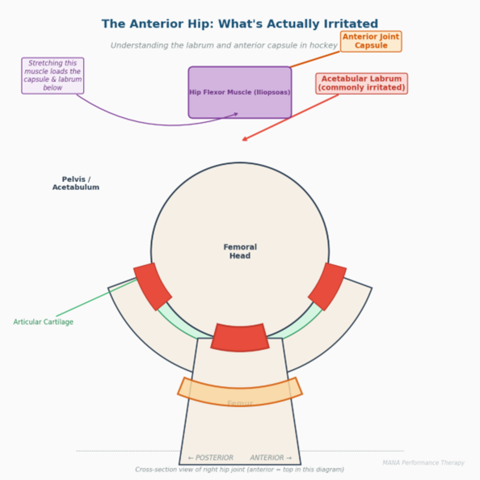
The labrum is a ring of fibrocartilage that lines the acetabulum (hip socket). Its job is to deepen the socket, create suction to keep the femoral head centered, and protect the joint from excessive movement. The anterior capsule is the connective tissue at the front of the joint that provides passive restraint against the femur sliding forward.
In hockey players, repetitive skating mechanics — especially the snap and extension through the stride — can create what’s known as femoroacetabular impingement (FAI): the femur essentially pinching against the rim of the acetabulum. Over time, this irritates the labrum and stresses the anterior capsule.
The result? Pain and pinching deep at the front of the hip, often described as a “C”-shaped ache. It’s provoked by hip flexion, internal rotation, and the end ranges of hip extension — all movements that are unavoidable on the ice.
Why Stretching the Front of the Hip Makes It Worse
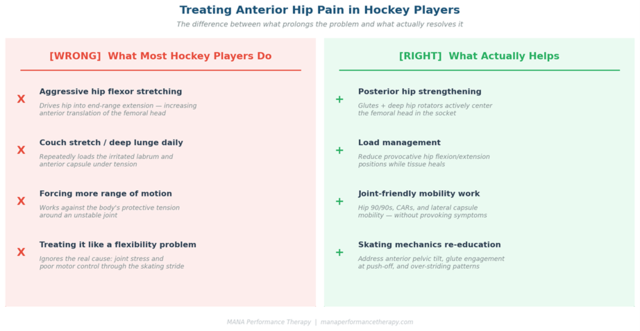
Here’s where the common approach goes wrong. When you perform a hip flexor stretch — a lunge, a half-kneeling hip stretch, a couch stretch — you are driving your hip into end-range extension. That movement does two things that are particularly problematic with labral or capsular involvement:
• It increases anterior translation of the femoral head. As the hip moves into extension, the femoral head has a tendency to glide forward in the socket. If the anterior capsule is already lax or irritated, that forward translation puts direct stress on the very tissue you’re trying to protect.
• It loads the anterior labrum under tension. Aggressive end-range stretching doesn’t just lengthen muscles — it also pulls on the capsule and labral attachment. If the labrum is already irritated or has a partial tear, repeatedly loading it at end-range extension can perpetuate the inflammatory cycle and slow healing.
• It reinforces a movement pattern that caused the problem. Hockey players already spend an enormous amount of time with the hip in flexion and then explosively extending through the stride. More hip extension work — without addressing joint centration and motor control — simply repeats the mechanism of injury.
Stretching the hip flexor muscles also does little to address the actual problem because the tightness you feel isn’t necessarily a length issue. It’s often protective tension — it's your brain guarding an unstable or irritated joint. Trying to force more range of motion into that situation is working against your body’s attempt to protect itself.
What Actually Helps
Managing anterior hip pain from labral or capsular irritation requires a different approach entirely. Rather than chasing flexibility, the focus should be on:
1. Joint Centration and Posterior Hip Strengthening
The goal is to keep the femoral head centered in the socket throughout movement. Exercises that strengthen the glutes, deep hip external rotators (the posterior hip), and hip abductors helps keep the hip in a good position — reducing the anterior shear that aggravates the labrum and capsule.
2. Load Management and Reducing Provocative Positions
Healing tissue needs load reduction, not more stress. Identify and temporarily dial back training that repeatedly drives the hip into the impingement zone — deep flexion, combined flexion-adduction-internal rotation — so the irritated tissue has a chance to settle down. You need to calm tissue down to then be able to build it back up. If you're just constantly making things angry, it'll take that much longer to recover.
3. Hip Mobility Work That Doesn’t Provoke Symptoms
Mobility is still important — but the approach matters. Constantly slamming the femur into the tissue that is aggravated is a fast way to have more pain that will just end up making you more frustrated. Work through ranges you feel you can tolerate and if pain does come on, get to that point and then back off.
4. Skating Mechanics and Movement Re-Education
In many hockey players, the skating stride itself creates impingement through poor hip mechanics — excessive anterior pelvic tilt, lack of glute engagement at push-off, or overstriding. Addressing the movement pattern that created the problem is essential for long-term resolution and preventing recurrence.
The Bottom Line
If you’re a hockey player with anterior hip pain and you’ve been hitting the hip flexor stretches with no results, it’s time to reconsider the strategy. The front of the hip is a complex area, and pain there is rarely just about tight muscles. More often, it’s a story about joint stress, structural irritation, and movement patterns that need to be addressed from the inside out.
Stretching into an irritated anterior capsule or labrum isn’t a solution — it’s adding fuel to the fire. The good news is that with the right approach, most hockey players can get on top of this and get back on the ice feeling better than they did before the injury.
Dealing with anterior hip pain and not sure where to start? At MANA Performance Therapy, we specialize in getting hockey players back on the ice with a clear, evidence-informed plan. Reach out to book a consultation — let’s figure out what’s actually going on with your hip.